

Physiotherapy in Kigali helps you recover from pain, injury and illness and get back to the things you need and want to do. Book an assessment and a licensed physiotherapist will examine you, explain what is likely causing your symptoms and agree a treatment plan with you. Sessions take place at our clinic or, if travel is hard, at home.
The NHS describes physiotherapy as a treatment that can ease pain and improve movement after injury, illness or disability, using exercise, manual therapy and advice. It is used for joint and muscle problems such as back pain, neck pain and arthritis, for sports injuries, for problems moving after a stroke and for recovery after surgery.
Conditions we commonly see
- Lower back pain and sciatica, including slipped disc symptoms. See back pain treatment.
- Neck and shoulder pain, tension headaches, rotator cuff problems and frozen shoulder. See neck and shoulder pain.
- Knee, hip and ankle problems, including osteoarthritis and recurring sprains.
- Sports injuries such as muscle strains, ligament sprains and tendon pain. See sports injuries.
- Recovery after fractures and surgery, for example after a hip or knee replacement or a broken wrist.
- Stroke and neurological rehabilitation. See stroke rehabilitation.
- Pregnancy-related back and pelvic pain, with gentle, adapted exercise.
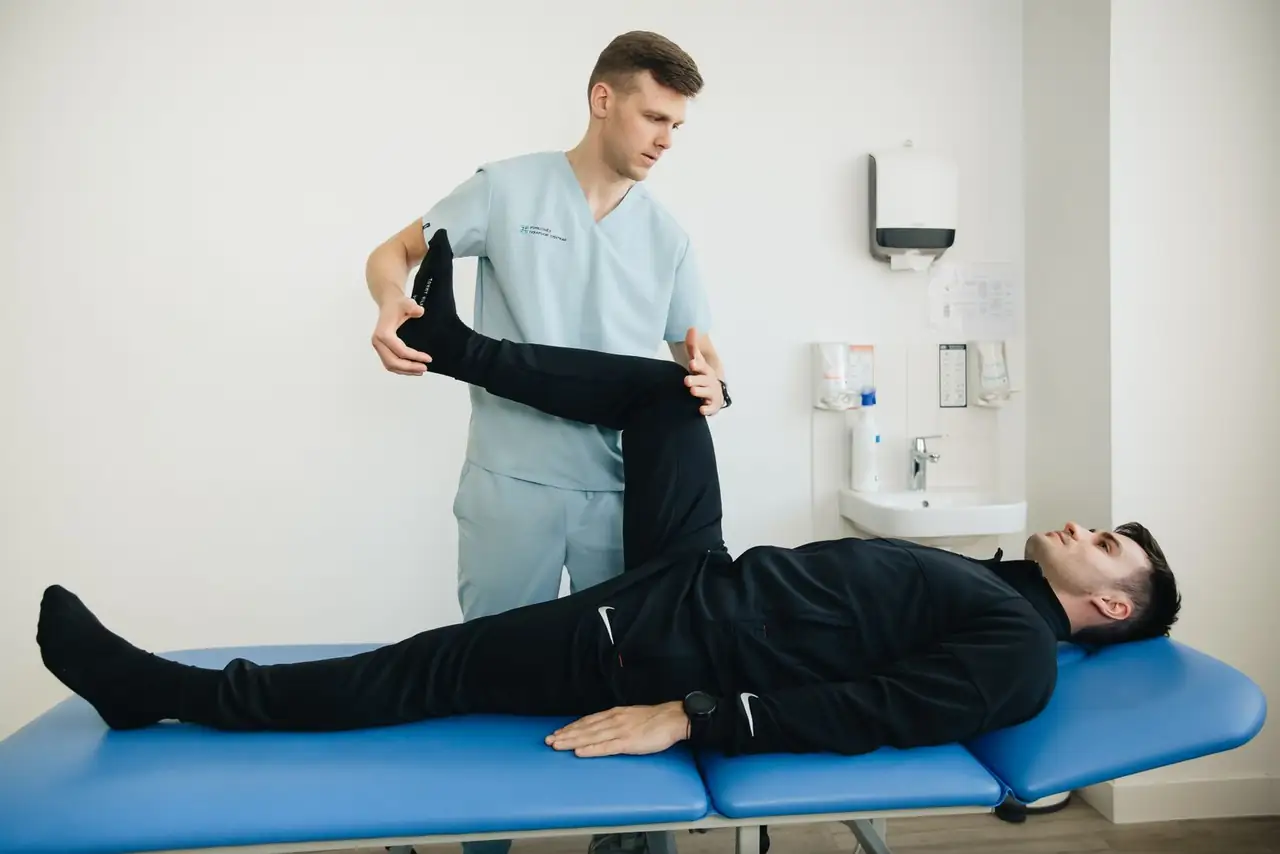
Your first appointment, step by step
A first visit usually takes longer than follow-ups. Here is what happens.
- Talk. We ask when and how the problem started, what makes it better or worse, how it affects work, sleep and sport, your medical history and medicines, and what you want to achieve.
- Screen for warning signs. We check for symptoms that need a doctor first, such as bladder changes, unexplained weight loss or weakness in both legs.
- Examine. We look at posture and how you move, test joint range, muscle strength and balance, and check nerve function when pain spreads into an arm or leg. Nothing is done without explaining it first, and you can stop at any time.
- Explain. We share our findings in plain language, including what we think is going on and how long recovery may take.
- Plan and start. You usually get some treatment and two or three home exercises on the first day.
Wear comfortable clothes that let us see the painful area, such as shorts for a knee problem or a vest top for a shoulder. Bring any scans, hospital reports, discharge notes, prescriptions and a list of your current medicines.
What treatment can include
Physiotherapy is not one technique. Your plan is built from a few main tools:
| Treatment | What it involves | Often used for |
|---|---|---|
| Exercise therapy | Strength, mobility, balance and stretching exercises, progressed over time | Almost every condition |
| Manual therapy | Joint mobilisation, soft tissue techniques and therapeutic massage | Stiffness and muscle pain, alongside exercise |
| Education and advice | Understanding your pain, pacing activity, posture, lifting and sleep | Back and neck pain, long-term problems |
| Gait and balance training | Walking practice, walking aids, stairs and falls prevention | Older adults, stroke, after surgery |
| Workplace and activity advice | Desk setup, breaks, safe return to work or sport | Office workers, drivers, athletes |
Exercise sits at the centre of most plans. UK guidance from NICE says that for low back pain, manual therapy should only be considered as part of a package that includes exercise. Hands-on treatment can ease pain in the short term; exercises and good habits are what help you stay better.
Typical follow-up sessions
Follow-up sessions are shorter. We check how you have responded since last time, review your exercises and make them harder (or easier) as needed, add hands-on treatment where it helps, and answer your questions. Over time, sessions become less frequent as you take over your own programme.
A useful rule of thumb from NHS physiotherapy leaflets: some discomfort while exercising is acceptable if it settles within about 30 minutes and you are not worse the next day. If an exercise causes sharp, shooting pain, stop and tell us.
Licensing, insurance and costs
Physiotherapists in Rwanda must be licensed by the Rwanda Allied Health Professions Council (RAHPC). Its website has a licence verification tool: enter the practitioner's licence number to check their status. You can ask us for ours at any time.
For payment:
- RSSB: the RSSB medical scheme lists physiotherapy among covered services. RSSB refunds care at health facilities that have signed an agreement with it, paying 85% of the bill while the member pays 15%.
- Private insurers: many private and employer health plans in Rwanda include outpatient physiotherapy, sometimes with an annual session limit or a doctor's referral requirement.
- Self-pay: fees depend on the session type and whether you need a home visit. Contact us for a current quote.
Check with RSSB or your insurer before the first session and ask whether you need a referral or pre-authorisation.
When to see a doctor first
Physiotherapy is not emergency care. Call 912 for an ambulance or go to a hospital emergency department if you have loss of bladder or bowel control, numbness around the genitals or inner thighs, weakness in both legs, a deformed joint after an injury, chest pain, or signs of a stroke such as a drooping face, arm weakness or slurred speech. See a doctor soon if pain comes with fever, unexplained weight loss or a history of cancer.
Clinic or home visits across Kigali
Most people come to the clinic, which has space for exercise. If you cannot travel easily, we offer home physiotherapy in Kigali in neighbourhoods such as Nyarutarama, Kacyiru, Kimihurura, Remera, Kicukiro, Kibagabaga, Kimironko and Gisozi.
Book your assessment
Fill in the form below with your name, phone or WhatsApp number and a short description of your problem. Choose "Physiotherapy assessment" and your preferred time, and we will contact you to confirm.
Frequently asked questions
Are physiotherapists in Rwanda licensed?
Yes. Physiotherapists in Rwanda are licensed by the Rwanda Allied Health Professions Council (RAHPC). The council lets the public verify a licence on its website by entering the practitioner's licence number, so you can ask any physiotherapist for theirs.
Will my insurance pay for physiotherapy?
It depends on your insurer and the facility. The RSSB medical scheme lists physiotherapy among covered services at facilities with an RSSB agreement, with the member paying 15%. Some private insurers cover physiotherapy as an outpatient benefit. Check with your insurer before your first session.
How many sessions will I need?
It depends on your condition, how long you have had it and your goals. After the assessment, the physiotherapist explains the expected number of sessions. Many people need a few sessions plus regular home exercises, while recovery after surgery or a stroke takes longer.
Do I need a doctor's referral?
You can book a physiotherapy assessment directly. Some insurers ask for a doctor's referral or prescription before they reimburse sessions, so check your policy. If we find signs that need medical review, we will refer you to a doctor.
Does physiotherapy hurt?
Some techniques and exercises can cause mild discomfort, but treatment should not be severely painful. Tell your physiotherapist how you feel at any time. A common guide is that exercise discomfort should settle within about 30 minutes and not be worse the next day.
What is the difference between a physiotherapist and a massage therapist?
A physiotherapist is a licensed health professional who assesses and treats injuries and conditions using exercise, manual therapy and advice. Massage is one hands-on technique. Physiotherapy suits new injuries, nerve symptoms and recovery after surgery, while massage suits general muscle tension.
Can I do physiotherapy at home?
Yes. We offer home physiotherapy across Kigali for people who cannot easily travel, including older adults and people recovering from surgery or stroke. Treatment at home also lets us check stairs, bathrooms and other daily challenges.